
Finding Out Which Paper Documents Your Team Actually Holds
Signed certificates, printed policies and countersigned letters often exist in a filing cabinet, a car boot or someone's desk drawer, and nobody has a list. This article shows how to map what paper your team holds, record it in a form people can search, and close the gaps before a deadline forces the search.
By EA Team
Contents
A bid team is finishing a response to a public sector framework. The questionnaire asks for a copy of the signed health and safety policy, the most recent training record, and evidence of professional indemnity cover signed by the broker. The policy is in the shared drive, but the version there is unsigned. The training record exists, but it is a printed sheet that someone signed in a meeting room two years ago. The broker's letter is probably in a paper file, although nobody is sure which one. The team spends most of Friday afternoon walking between desks, the stationery cupboard and the basement. They find the broker's letter in the second file they open. The training record is never located. The response goes out with a note explaining the gap, and the team agrees to fix the problem after the deadline.
This article covers how to run a short discovery survey of paper records, decide which items deserve a digital copy, and keep the register current with owners and review dates. A clear list of what exists is the difference between a quick answer and a Friday-afternoon search.
Why paper records drift out of view
Paper documents fail quietly. A signed copy is created for a specific purpose, filed by whoever signed it, and rarely referenced again until someone needs it. The digital version, if one exists, may be a draft or an earlier version, and the signed original stays wherever it was put. Over a few years, the team's most important evidence sits in several places, with no index and no owner.
That is why the search feels so hard. The team has been careful, but paper has no search function, and the person who knows where a document lives may have left the organisation.
Run a short discovery survey
Choose a quiet week and run a simple survey. Ask each team to list the paper records they hold that are likely to be requested by a client, an auditor or a buyer. Give them a short list of prompts: signed policies, certificates, training sign-offs, insurance letters, contracts with signatures, and printed reports that were sent to clients.
For each item, record what it is, the date, who signed it, where the original sits, and whether a digital copy exists. Note the location as specifically as possible, such as the room, the cabinet, and the drawer. A record that says "the basement" will not help anyone in a hurry.
Decide what goes into the digital record
Not every paper record needs to be digitised. Focus on the documents that clients and buyers ask for most often, and on any document whose absence would stop a response. Those usually include signed policies, current certificates and anything with a signature that a buyer may need to see.
For each document you choose, scan the signed original and upload the image to the relevant workspace in EA. Keep the original paper, and record in the inventory that the digital copy is the one to use for a response. If the scan is only an image without searchable text, note that too, because it will not be easy to quote from until the text has been extracted. Getting text back out of scanned pages covers that step.
Make the inventory useful to the bid team
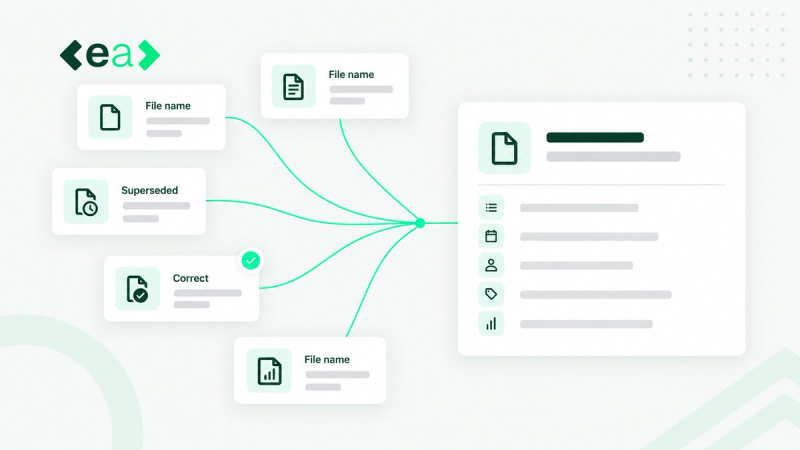
The inventory has value only if the bid team can find things in it. Keep a single register that lists each item, its owner, its digital location, and the date it was last checked. Link each item to the questions it supports, so that when a questionnaire asks for a signed policy, the coordinator can find the item in a minute. Keep those links in the register, where the whole team can see them, and a question with no linked record becomes a prompt to find or create the evidence before the deadline.
EA's Storage holds the digital copies once they are uploaded, and the team can search them alongside approved policies and evidence. The paper originals stay where they are; the register tells people where to find them. For a related approach to evidence records, the EcoVadis evidence review record shows how a simple log keeps evidence in order between reviews.
Set a review date and an owner
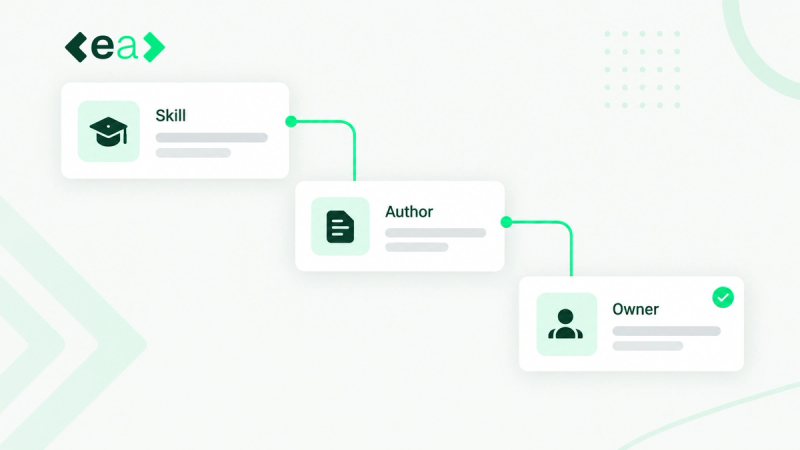
A discovery survey tells you what exists, not who keeps it current. Assign an owner to every item on the register, usually the person who signed it, the manager of the team that holds it, or the compliance lead for that area. Set a review date, perhaps twice a year, tied to renewals for certificates and insurance. At each review the owner confirms the item is still correct, and anything expired or superseded comes off the register.
Ownership matters most for documents with an expiry date. A certificate or insurance letter that lapses unnoticed will surface in the middle of a bid. Put the expiry date in the register and set a reminder with the owner thirty days before it falls due.
When the survey finds a gap, such as a signed training record that was never filed, treat it as a task with an owner and a date. A gap noted only in a meeting tends to disappear. Where a record cannot be recovered, record that too, with the steps you have taken to replace it. A buyer is more likely to accept a documented alternative than a silence.
Separate the signed record from the working copy
Many teams keep a signed paper copy and an unsigned working file that differ in small but important ways. The working file may carry a later date, an updated name, or a clause that was negotiated after signature. When a buyer asks for evidence, they want the signed version. Make that distinction explicit in the register, so the coordinator never sends an unsigned draft in place of a signed record.
Where a document has been superseded, keep the old signed version in the archive and mark the new one as current. A clear chain of versions lets you answer a question about what applied on a given date, which buyers ask more often than teams expect.
Start before the deadline is close
Finding out what paper your team holds is a dull task, and it is one of the most useful things a bid team can do. A short survey, a clear register and a set of digital copies turn a frantic Friday search into a five-minute check. The work does not need to be perfect. It needs to be started before the deadline is already close.
If your evidence library still depends on paper originals, book a demo with EA and we can talk through how to bring the signed copies into a workspace your bid team can search.
Filed under Compliance Knowledge & Evidence, 28 October 2026All posts
Keep reading