


Why sovereign AI
The control that lets your organisation say yes to AI.
The first questions risk and legal ask about any AI service are where the content goes and who decides. Sovereign AI settles both before they are asked, so you can hand AI the work your organisation answers for. With EA, that work stays inside what you’ve approved.
What it means
Sovereign AI is control, held by the organisation that answers for the work.
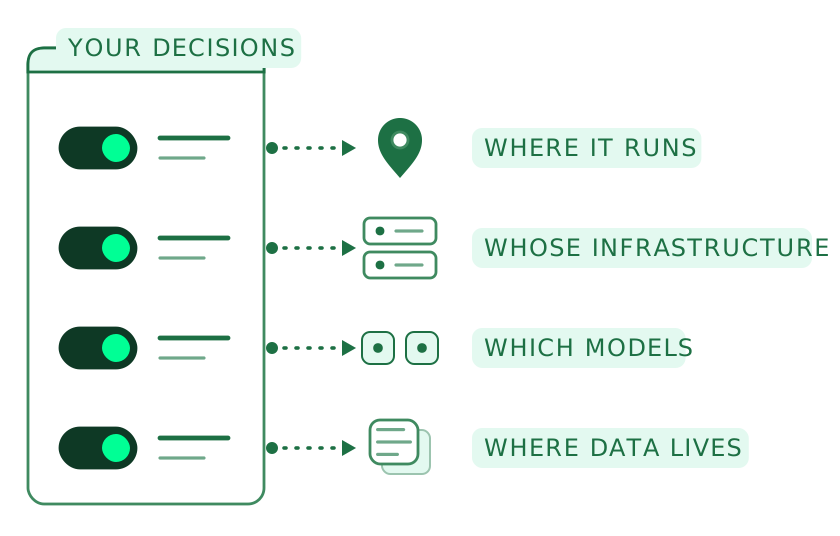
It describes who decides, not a place on a map. Your organisation chooses where its AI runs, whose infrastructure that is, which models process its content and where its data lives, against its own obligations. With those choices settled and written into the agreement, the people who want to use AI and the people who must approve it can agree on the same terms.
Organisations that run work on EA





Why now
Why control over AI has become a board question.
AI now does work your organisation answers for
It drafts what you send to clients, regulators and auditors. Whoever signs that work should know where it ran and what processed the content on the way.
Your obligations travel with your data
Data protection, operational resilience and sector rules ask where your data is processed, by whom, and how you would leave. An AI supplier is now part of that chain.
Control decides how far you can go
Settle where AI runs and which models it uses at the start, and AI can take on the sensitive work too, rather than stopping at whatever passes a review.
Where organisations stand
Boards are already deciding where their technology runs.
Digital sovereignty has moved from the IT team’s checklist to the board’s agenda, and AI is where organisations plan to invest in it next.
- 93%of organisations have discussed digital sovereignty at board level
- 69%agree that digital sovereignty requires the capacity to choose their technology dependencies
- 60%of European organisations plan to invest more in sovereign AI over the next two years
Sources: Capgemini Research Institute, Digital sovereignty survey, April 2026 (1,300 executives); Accenture, sovereign AI research, 3 November 2025 (1,928 organisations, July to August 2025).
What the rules ask
A check your team can run, rule by rule.
Each of these asks you to know where your technology runs and who handles your data, and to be able to show it. When those answers are settled in writing, checking a supplier against them is quick. Sector regulators add their own expectations of outsourcing and third parties.
Resilience and security
- DORA, for EU financial entities
Since 17 January 2025, contracts for ICT services must state where functions are provided and where data is processed and stored, and services that support critical or important functions need an exit strategy.
- NIS2, for essential and important entities
Entities must manage the security risks in the systems they rely on, including supply chain security: their relationships with their direct suppliers and service providers.
Data and AI
- GDPR, for personal data
Chapter V sets the conditions for transferring personal data outside the European Economic Area, and UK GDPR has its own rules for transfers from the UK.
- The EU AI Act, for deployers
Organisations that deploy high-risk AI systems must use them as instructed, assign human oversight to people with the authority for it, and keep the logs under their control.
Sovereign AI at EA
Hand AI the work you answer for. It stays inside what you’ve approved.
At EA, sovereign AI covers more than where it runs. What EA says, where it runs and who releases the work all stay inside what your organisation has approved, and EA tells you plainly when something reaches the edge.
What it says
- Drafted only from approved answers
EA drafts from the answers and documents your organisation has already approved, and shows where each answer came from.
- Needs evidence, not a guess
Where the approved material doesn’t answer a question, EA marks it “Needs evidence” and takes the gap to the person who holds the evidence.
Where it runs
- The deployment you choose
EA’s cloud in a region you choose, hybrid or on your premises. Your choice is recorded in your client agreement, and EA changes it only as that agreement permits.
- Only the models you allow
You decide which models process your content and can exclude any of them. If an exclusion would stop the service working as described, EA says so before applying it.
Who releases it
- Approved by name
Each part goes to the people who check it and a named approver. Nothing goes out until the accountable person approves it.
- A record of who approved what
EA keeps a record of who drafted, reviewed and approved each part, ready for the next person who asks.
Where EA runs
Start from your obligations, then choose where EA runs.
Host in EA’s cloud in a region you choose; hybrid and on-premises options available. Each one answers a different obligation, and each keeps the same controls.
 When your obligations name a jurisdiction
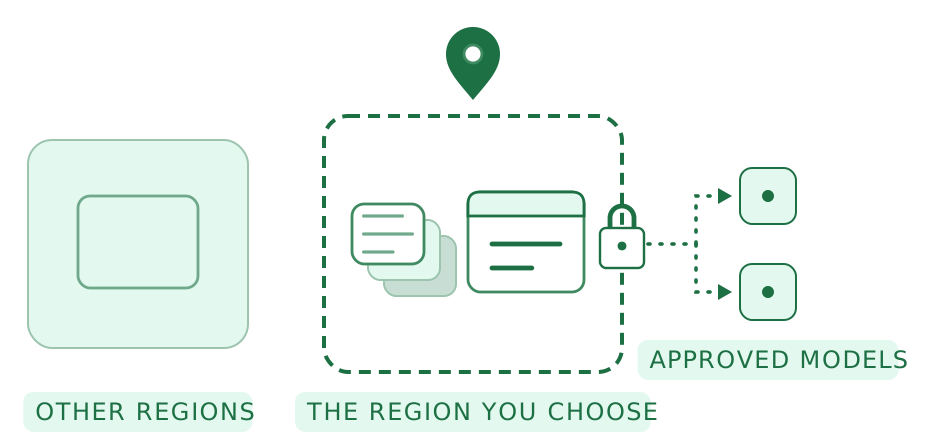
EA’s cloud, in the region you select, with your content, its logs and backups kept there.
 When content must stay in your environment
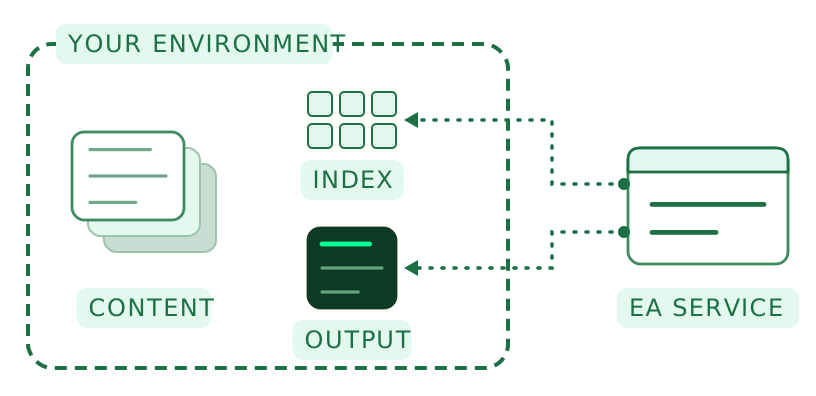
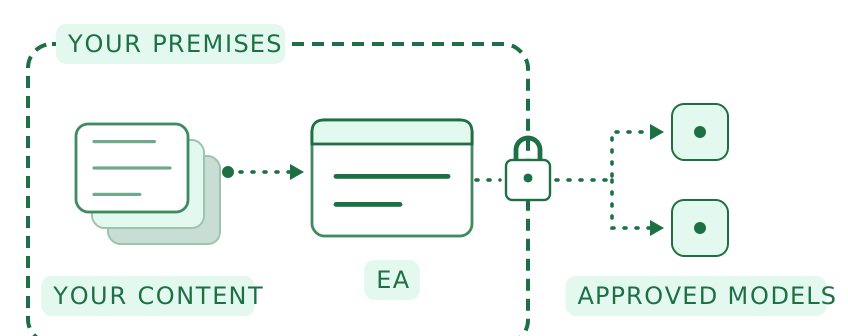
Hybrid: your content, files and retrieval index stay in your own environment, and EA’s service runs the work against them.
 When the platform must run inside your controls
On your premises: EA runs inside your infrastructure, under your network, identity and security controls, with the models you allow.
Proof you can check
- A sub-processor list with each one’s region and transfer mechanism
- 30 days’ notice before a new sub-processor handles your data
- Certificates and evidence within five working days, under confidentiality
- A right to audit the deployment, residency and model commitments
Questions to ask
Four questions for any AI supplier, and EA’s answers.
Put them to every supplier on your list. The answers show who holds the control once the contract is signed.
| Ask any AI supplier | Why it matters | EA’s answer |
|---|---|---|
| Where will it run, and can we choose? | Your obligations may name a jurisdiction, or need the AI inside your own environment. | Host in EA’s cloud in a region you choose; hybrid and on-premises options available. |
| Which models process our content? | Each model that processes your content is part of the chain your supplier review has to cover. | You decide which models process it, from those EA has approved, and you can exclude any of them. |
| Is our data used to train the models? | Training is a use of your content that your agreement should settle in writing. | Data never used to train the models EA runs on. |
| Can we take everything with us? | An exit plan is part of managing any technology supplier. | Export your content in full, in open formats, during the term and for 30 days after it ends. EA deletes it within 30 days of termination and confirms it in writing. |
Bring your hosting requirements to a demo. We’ll show EA on a piece of your own work and go through how the deployment you need would run.
EA’s own security
Control you can check, not just take on trust.
EA is ISO 27001 and Cyber Essentials certified and follows SOC 2 security practices. Check each certificate on its register; the security policy sets out how EA protects the platform and your information.
Information security
ISO 27001 certified
Information security management, independently audited.
Issued by British Assessment Bureau, accredited by the UK Accreditation Service (UKAS)
Since October 2026
Verify on UKAS CertCheck
Cyber security
Cyber Essentials certified
Certified under the UK government-backed scheme, renewed each year.
Search the Cyber Essentials register
Controls your administrators hold
Workspaces, permissions and single sign-on your administrators control.
The enterprise page covers who can open each workspace, what each permission group may do and how sign-in is enforced.
See enterprise security and permissions
FAQ
What buyers ask about sovereign AI.
Short answers, with the page to read next.
AI your organisation controls. You decide where it runs, whose infrastructure it runs on, which models process your content and where your data lives, and those decisions are written into your agreement with the supplier. At EA it also covers what the AI says and who releases the work: drafts come only from approved answers, and a named person approves them before they go out.
Not necessarily: it means the choice is yours. Many organisations meet their obligations with a cloud service in a region they choose; others need the AI inside their own environment or on their premises. With EA, host in EA’s cloud in a region you choose; hybrid and on-premises options available. See where EA can run.
Several ask for the control sovereign AI describes. DORA requires EU financial entities’ ICT contracts to state where data is processed and stored, and asks for an exit strategy for critical services. GDPR sets the conditions for personal data leaving the European Economic Area, and UK GDPR has its own transfer rules. NIS2 covers the security of an entity’s suppliers and service providers, and the EU AI Act asks deployers of high-risk AI systems to keep human oversight and the logs under their control. Your sector regulator may add its own expectations.
Yes. You decide which models process your content, from those EA has approved, and you can tell EA to exclude any of them. Not all of them process in the UK or the European Economic Area, so the published sub-processor list states each one’s region and transfer mechanism for your team to check.
EA applies the exclusion within five working days. If it would stop the service working as described, EA tells you before applying it, so you decide with the facts in front of you.
A fully redundant cloud service, in the region you choose. EA operates the service there and keeps your content, its logs and backups in that region. If your content must stay in your own environment, choose a hybrid or on-premises deployment instead.


Your next piece of work, inside what you’ve approved.
Bring your hosting requirements and one piece of open work.
Related
Where the controls continue.
Read next
- Sovereign, under your controlWhere EA runs and which models process your content, set against your obligations.Hosting options
- Enterprise security and permissionsWorkspaces per entity, permission groups and single sign-on you can enforce.Product
- Security policyHow EA protects the platform and your information.
By industry
 Banking and building societiesSupplier reviews and resilience work, each team in its own workspace.
 InsuranceEach entity’s reports and broker due diligence, kept apart and approved by name.
 Public sector and defenceSelection questionnaires, declarations and the carbon reduction plan, signed off by the right director.