

How to Keep Signed Originals Findable When an Auditor Asks
An auditor asks for the signed original of a contract or certificate, and the team knows it exists but not which box holds it. This article covers the questions an auditor actually asks, how to record retention and destruction, and what to check before you use an external storage provider.
By EA Team
Contents
An audit request for a signed original tests your records, not your memory. If the register cannot say which box holds a contract, or when a certificate expired, the answer takes days instead of minutes, and the gap shows up in front of the auditor.
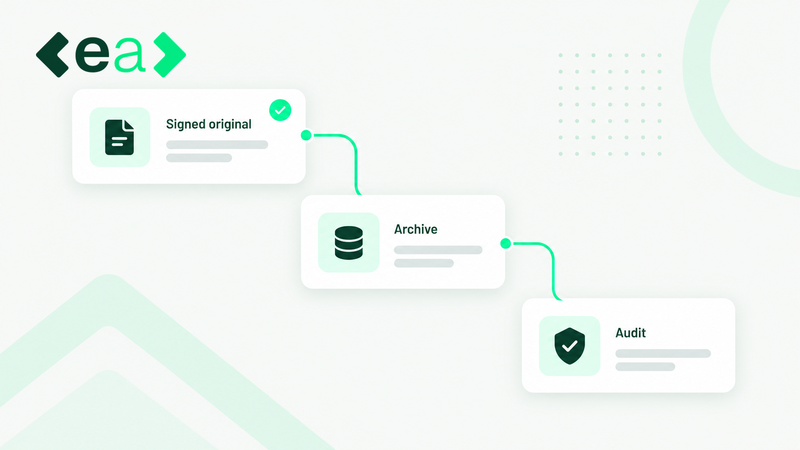
This article covers the three things that decide whether a paper register survives an audit: the columns an auditor's questions actually turn on, the record of retention and destruction, and the retrieval route when the paper sits with a third party. It assumes you already keep a register of your paper records, as finding out which paper documents your team holds sets out, and it shows what that register needs in order to answer an audit.
Build the register around the auditor's questions
Auditors ask in predictable ways. They want to know which contracts were in force on a given date, which certificates were valid when a service was delivered, and which signatures were applied by an authorised person. Each of those questions is about a date, a party or a signatory. A label on a box tells you none of it.
So the register needs those columns, not just a location. For contracts, add the effective date, the expiry, the parties and the authorised signatory. For certificates, add the issuing body, the scope and the validity period.
Record retention and destruction
When a retention period ends, the disposal of an original should be a deliberate and recorded decision. Note the item, the date, the approver and the method in the register before anything is destroyed. If the auditor later asks for a document that was destroyed under the policy, that record shows the decision was made correctly and when.
Keep the digital copy for as long as the retention rule requires, even after the paper has gone. The scan often becomes the only evidence that a signed document ever existed, so its storage and its register entry deserve the same care as the original.
Record every move
A box is moved to a new site, a cabinet is cleared during an office refit, or a set of files goes to a storage provider. Each move can break the link between the register and the original, so record every movement on the day it happens. A move that goes unrecorded is the most common reason an original cannot be found later.
Check the retrieval route before you need it
If the paper sits with an external storage provider, keep their reference for each box or file in your register, and confirm the provider can retrieve an item within the time your audit allows. Ask for a retrieval timetable in advance, so you know how long a request will take before an auditor is waiting on it. A provider that takes a week to produce a box is a problem you want to discover in a quiet month, not during an audit.
Rehearse the request
When an audit is announced, pull the register entries for the requested documents and check each one. Confirm the digital copy, confirm the physical location, and walk the team through a dry run for one item. The dry run finds the gaps while there is still time to fix them. Keep a note of what was provided to the auditor, with the reference for each document, so the next request is faster.
Answer the request from the register
The register is what turns an audit request into a short, confident lookup. Give it the columns the auditor's questions turn on, record every move and every destruction, and check the retrieval route before you need it. The paper can sit anywhere, as long as the register knows where.
If your team is preparing for an audit or a records review, book a demo with EA and we can talk through how to keep digital copies and their references in one searchable place.
Filed under Compliance Knowledge & Evidence, 2 November 2026All posts
Keep reading