

Certificate Management: Spotting Expiry Dates Before They Hit a Bid
A certificate that lapses during a bid is often discovered only when the buyer asks for it. This article shows how to find certificates that will expire before submission or award, and how to plan the renewal around the bid timetable.
By EA Team
Contents
- Why expiry dates are missed
- Building a register that the bid team can use
- Checking against the tender timetable
- How EA helps you spot expiry dates early
- Telling the buyer clearly
- Handling a certificate that cannot be renewed in time
- Making the renewal a scheduled task
- A practical check before each bid
- Where this leaves your certificates
A facilities services company is shortlisted for a public contract. The submission is due in five weeks, and the team has a valid ISO 9001 certificate and a current ISO 14001 certificate, both in the response. Three weeks in, the team checks the certificates for the attachment list and finds that the ISO 14001 certificate expires two weeks after the submission deadline and before the contract start date. The surveillance audit has not been booked. The renewal takes longer than expected, and the company submits with a note that explains the position. The buyer asks for clarification, and the account team spends a week assembling the evidence.
The certificate was valid, and the team had no reason to doubt it. What was missing was a date check against the timetable of the bid.
This article explains why expiry dates get missed, what a certificate register needs to hold, and how to check it against a tender's timetable so a renewal is scheduled and not discovered. It also shows how EA connects a certificate to the answers that cite it, so the check happens where the response is written.
Why expiry dates are missed
Certificates are usually filed when they are received. The expiry date sits in the document, rarely in a place the bid team reads. The people who hold the certificate may be in quality or compliance, and the people who write the bid may not know the renewal dates. Each group assumes the other is tracking them.
The date is easy to miss because it is far away when the certificate is filed. A certificate that expires in fourteen months does not feel urgent until a bid makes it so, and by then the renewal may be hard to complete in time.
Building a register that the bid team can use
A certificate register should list each certificate, its scope, its issue date, its expiry date and the owner responsible for renewal. The scope matters, because a certificate may cover some sites or services and not others. A bid may need evidence for a specific scope, and a valid certificate for the wrong scope is not the same as the right one.
Keep the register in one place, and make sure the bid team can see it. A register that only the quality manager can open does not help the person preparing a submission.
Checking against the tender timetable
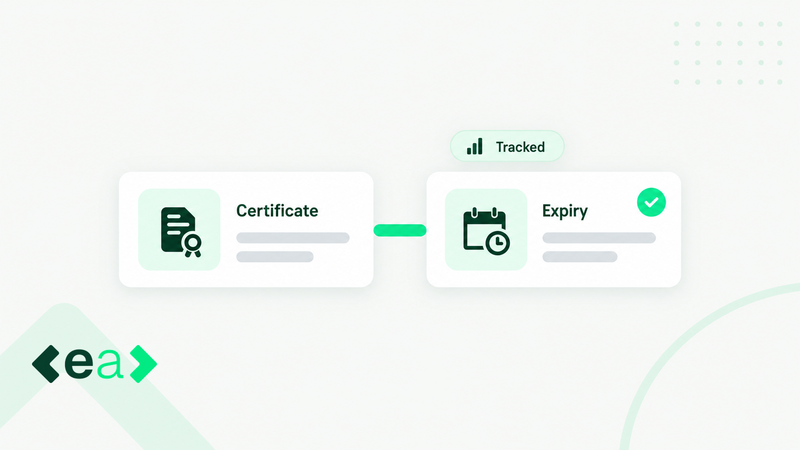
Compare each expiry date with the submission deadline and the contract start date. A certificate that expires before submission needs renewal now. One that expires between submission and award needs a plan, because the buyer may ask for evidence of current certification at the award stage. One that expires after the contract starts may still need monitoring, because many contracts require certification throughout the term.
Add a renewal lead time to each date. Certification bodies may need weeks to schedule an audit, and the renewal date should sit ahead of the bid timetable by that margin.
How EA helps you spot expiry dates early
EA reads approved documents from your Storage, and it answers with sources shown. When a certificate is held as an approved document, an answer that relies on it shows which certificate is cited, so the team can check its dates against the bid. Answers carry statuses and version history, which show when the certificate evidence was last updated. Named reviewers can be assigned to check certificate-dependent answers before a submission goes out.
The register still needs an owner and a regular date review, and the certification body's renewal process stays with your quality team. What EA adds is the link between the certificate and the answers that depend on it, so a lapsing certificate is visible where the bid is written. For how to keep reviews moving when a specialist is away, our article on who checks an AI answer when the subject expert is away sets out a cover approach.
Telling the buyer clearly
If a certificate will expire during the process, say so in the response. Give the current expiry date, the date of the next audit or renewal and the name of the certification body. A clear statement with a dated plan is far stronger than a certificate that appears valid and then lapses.
Handling a certificate that cannot be renewed in time
Sometimes a renewal will not complete before submission or award. The honest response is to state the position: the current certificate, its expiry date, the date of the renewal audit and the certification body involved. Where the body can provide a letter confirming that an audit is booked, that letter is useful supporting evidence, and the team should attach it with a dated note.
Decide who takes the buyer-facing decision before the bid, usually the bid lead with the quality lead. A clear, dated statement from a named person is easier for the buyer to accept than a certificate that appears valid until the day it lapses.
A renewal owner should also tell the approver when the position changes. Our article on how external requests get internal approval describes how requests that come in from outside the team are routed to the right internal approver, which is the route a renewal update should follow.
Making the renewal a scheduled task
A renewal that is written in a register but never assigned will still be missed. Give each expiring certificate a named owner, a renewal date and a checkpoint two weeks before the bid deadline. At the checkpoint, the owner confirms in writing whether the renewal is on track, and the bid lead decides what the response will say if it is not.
Scorecard and certification work share a common weakness: gaps are noticed but not owned. Our article on turning EcoVadis scorecard gaps into assigned actions explains how to give each gap an owner and a date, and the same approach keeps a renewal from drifting until the buyer asks.
A practical check before each bid
Open the register at the start of every bid. List each certificate the response will cite, and compare its expiry date with the submission and contract dates. Flag any that expire inside the window, and name the owner who will confirm the renewal.
Ask the owner for the renewal date in writing, and add it to the response as a dated note where the certificate is cited.
Review the register after each renewal, and set reminders for the next audit date, as well as the expiry date.
Where this leaves your certificates
A lapsing certificate usually comes down to a date nobody placed next to the bid timetable. A register with scope, expiry and owner, checked against each tender, lets the team schedule renewals and tell the buyer the truth early. EA helps by connecting the certificate to the answers that cite it, with statuses and version history, so the check happens where the response is written.
Open your certificate register this week and add a column for the next expiry date against each tender you have open. Flag any that fall before award. To see how certificates appear as sources in answers, open a certificate-linked answer in EA.
Filed under Compliance Knowledge & Evidence, 25 November 2026All posts
Keep reading