
How Can AI Support B Corp Work While Keeping Human Judgement Visible?
B Corp AI can help teams find evidence, organise information and prepare response drafts. People retain responsibility for interpreting requirements, checking sources and approving the final submission.
By EA Team
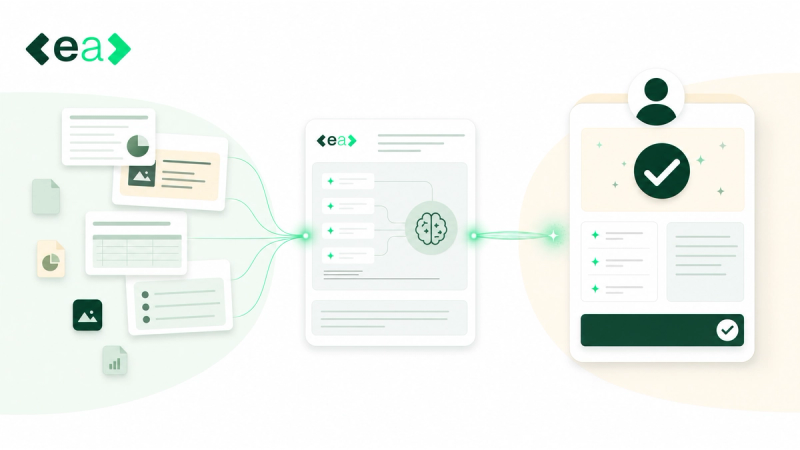
A B Corp assessment may require evidence from across an organisation: HR policies, environmental data, procurement records, governance documents, training records and previous submissions. Bringing that information together takes time, especially when files sit in different systems and responsibility is spread across several teams.
B Corp AI can support this preparation by finding relevant evidence, organising it around each question and producing a first draft. People remain responsible for deciding what the evidence means, confirming that it applies and approving the response.
Find and organise the evidence
The first practical use of AI is evidence retrieval. A controlled system can search approved organisational knowledge and identify documents that may support a particular B Corp question. This gives the responsible person a quicker route from requirement to source.
The source still requires human review. A policy may apply to one department, region or date range. A training record may show that an activity took place without demonstrating its scale or impact. A target may exist without a clear owner or review process.
The reviewer needs to check the source’s scope, date, ownership and relevance to the specific requirement. AI can reduce the time spent searching and sorting; professional judgement establishes whether the evidence supports the claim.
For organisations preparing a wider assessment, this evidence-mapping approach can also highlight missing information and unclear ownership. See B Corp gap analysis with AI for related guidance.
Prepare drafts for informed review
Once relevant sources have been found, AI can help turn them into a structured response. It can summarise a policy, bring together supporting documents and suggest wording that reflects the evidence available.
A draft is a starting point for review. The responsible person should confirm that:
- the answer addresses the question directly;
- each claim is supported by an appropriate source;
- the evidence covers the organisation’s relevant scope;
- the wording separates current practice from future plans; and
- any uncertainty or evidence gap is clearly recorded.
This review gives people a visible decision point. They can amend the draft, request clarification, add a source or record that further evidence is required. The workflow preserves the reasoning behind the final answer and makes approval accountable.
Keep the process controlled and useful over time
B Corp work often reveals practical improvements: an outdated policy, inconsistent data collection, an unclear metric or a responsibility that has never been formally assigned. A useful AI workflow captures these findings alongside the response itself.
Approved answers, corrections and updated evidence can then support the next assessment cycle. Recurring questions become easier to resolve, while repeated gaps become opportunities for better policies, measurement and ownership.
Control also includes information handling. Organisations should decide which evidence an AI system can access, where processing takes place, how outputs are reviewed and how records of decisions are retained.
These controls give AI a defined role in the process: retrieve trusted information, organise it, support drafting and surface questions for human review. People remain responsible for the organisation’s claims and commitments.
How EA can support B Corp preparation
EA brings approved organisational knowledge, previous responses and supporting documents into a searchable Knowledge Base. It can help a team move from a B Corp question to relevant sources and a clear draft, while keeping the evidence visible to the person responsible for the answer.
Reviewers can refine the wording, identify gaps and approve the final response within a structured workflow. Corrections and improved evidence can support future work, creating a more consistent preparation process over time.
This evidence-led approach gives teams a practical way to use B Corp automation while keeping judgement visible. Explore B Corp certification made simpler with automation for related context, and see why generic AI tools break down in ESG reporting and RFP workflows.
If you want to see how EA supports evidence-led B Corp preparation, book a demo or try EA free for seven days.
Filed under Using EA, 26 August 2026All posts