Generic AI tools have quickly become a go-to solution for most business tasks. Be it writing faster, responding to questionnaires, or supporting ESG assessments, these tools are increasingly positioned as the default starting point for getting work done.
Whilst this acknowledges the strengths of AI in accelerating content creation, it overlooks the fact that many of these activities sit within far broader, more structured workflows that extend well beyond drafting text.
In this context, the issue with generative AI stems from the fact that reporting workflows are not solely built around that skill alone. They are built around assigning work, retrieving evidence, reviewing responses, managing approvals, and ensuring that every single submission reflects the latest available information across the organisation.
This is why many teams discover that while generic AI delivers first drafts, it struggles to support the work that surrounds them.
No Workflow Context
Generic AI works one conversation at a time, but reporting workflows don’t.
A single RFP response, ESG assessment or supplier questionnaire can involve contributions from teams across an organisation. Commercial teams may manage customer requirements, sustainability teams provide ESG data, legal teams review compliance statements, and subject matter experts contribute technical information.
With these various contributors comes the challenge of coordinating the people, information, and processes required to complete the submission successfully.
Without the ability to identify who owns a particular section, know when a response is ready for review, track which contributors still need to provide information or manage approval stages before submission, this is something that generic AI cannot help with.
This creates a gap between what AI can generate and what reporting teams actually need.
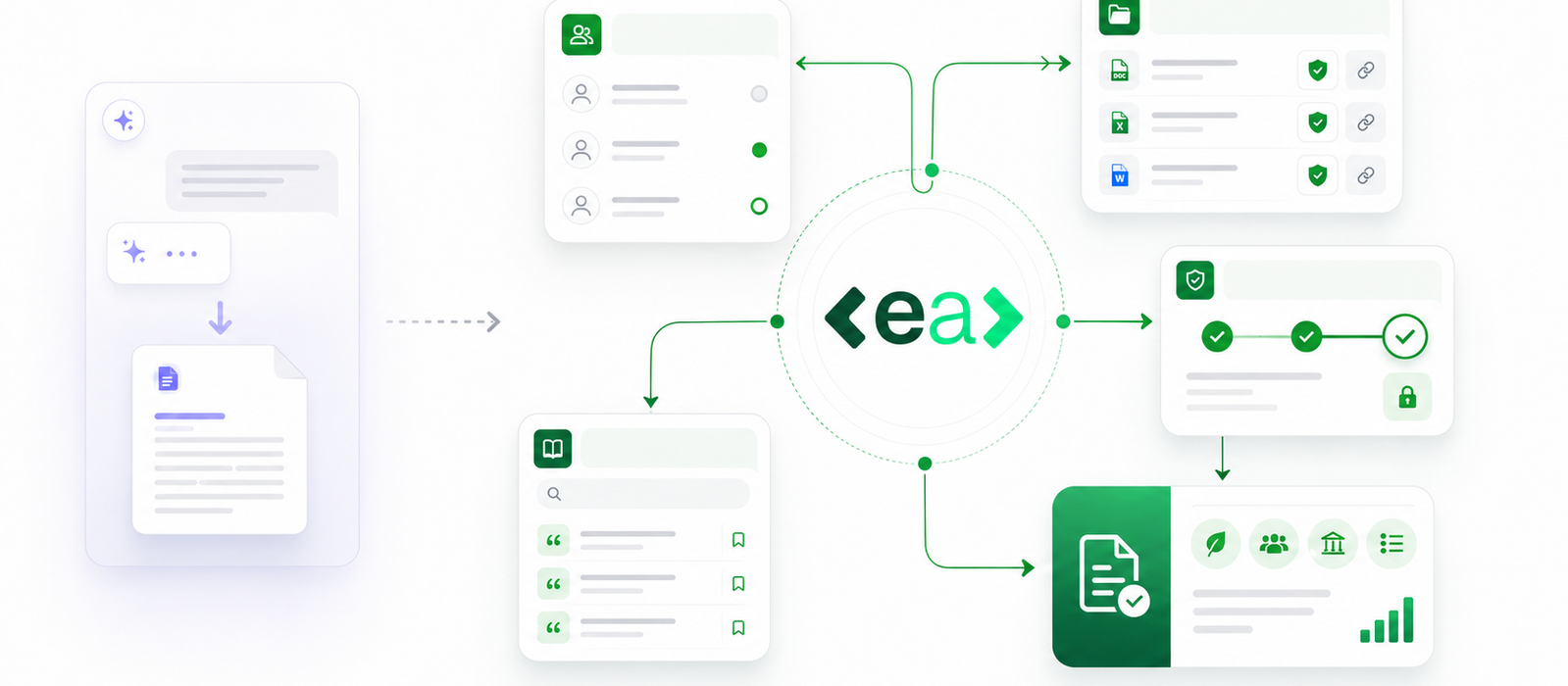
EA is designed around this reality. Rather than operating as a standalone writing assistant, EA supports the complete reporting workflow by allowing teams to collaborate within a structured environment. Contributors can be assigned specific tasks, responses can move through review and approval stages, and everyone involved has visibility into the progress of the submission.
However, collaboration is only one part of the challenge with generic AI use. Once the right people are involved, organisations still need confidence that every response is accurate, approved and supported by the right evidence.
Governance vs Generation
For enterprise reporting, speed alone is not enough.
A fast response that contains outdated information, unsupported claims, or unapproved messaging/ language can create significant risk. Whether completing an RFP or responding to an ESG framework like EcoVadis or CDP, organisations need confidence that every single sentence reflects the latest available information.
Generic AI tools struggle here because they do not naturally have the access to any of this information, nor the skillset to utilise it reliably. They cannot know which document should be used, whether a policy has been updated, which evidence supports a particular claim, or whether a response has already been reviewed and approved.
Each of these decisions rely on governance.
Purpose-build platforms like EA bring structure to this process by connecting AI with trusted organisational knowledge and reporting workflows. Teams then have the ability to do with EA what they cannot with generic AI tools: approve information, link supporting evidence to responses, and maintain visibility over changes throughout the entire submission process.
For AI in ESG, this is particularly significant because organisations must demonstrate where information comes from, provide supporting documentation, and ensure there is consistency across numerous assessments and reporting cycles.
By combining AI with evidence management and review workflows, EA helps teams improve efficiency without needing to sacrifice accuracy or confidence.
Once reporting teams have the structure and governance needed to produce reliable submissions, the next opportunity is reducing the repetitive manual work that slows these processes down.
Where AI Creates Real Efficiency
Despite the fact that purpose-built AI can produce a first draft faster than you or I could finish reading this sentence, many would argue that its greatest value actually comes from somewhere else: the reduction of repetitive work.
Reporting teams rarely start every submission from scratch. RFPs, ESG assessments and supplier questionnaires often contain similar requirements, recurring questions and information that needs to be adapted rather than recreated.
Yet, without a structured system in place, teams can still spend significant time searching through previous responses, locating supporting documentation and manually updating answers for each new submission.
This repetitive work does not just slow teams down. It also creates unnecessary risk. When responses are recreated manually, organisations are more likely to use outdated information, introduce inconsistencies or spend valuable expert time reviewing content that already exists.
Whilst generic AI tools are not designed to understand recurring requirements, reuse approved organisational knowledge, or maintain consistency across multiple submissions, EA was built for it.
EA helps teams transform this process by making approved organisational knowledge easier to reuse and adapt. Instead of repeatedly searching through previous submissions and documents, teams can retrieve relevant information, generate contextual drafts and refine responses within the same workflow.
Through EA Agents and connected integrations, organisations can also bring information from the systems they already use into the reporting process, helping teams access the knowledge they need without relying on disconnected tools or manual searches.
This is a reporting process where experts spend less time completing repetitive tasks and more time applying their knowledge to improve the quality, accuracy and impact of every submission.
Why Purpose-Built AI Outperforms Generic Tools
Generic AI has transformed how organisations approach content creation, but reporting requires something broader.
Completing an RFP, ESG assessment or supplier questionnaire involves far more than generating text. It requires collaboration, governance, evidence management and automation working together throughout the process.
This is where purpose-built AI creates a different level of value to generic AI.
EA combines AI-powered drafting with structured workflows, trusted knowledge, evidence management and collaboration tools designed specifically for complex business reporting. Instead of asking teams to adapt their processes around AI, EA integrates AI into the workflows they already rely on.
The future of reporting is not about replacing people with AI, but giving teams the tools to work more efficiently, make better decisions and complete complex submissions with greater confidence.
Want to see how EA can integrate into your RFP or ESG workflow? Book a demo or try it free today.