Those responsible for responding to RFPs know that writing the final response is only one part of the process. The most difficult part comes before that: finding the right information, gathering input from across the business, and ensuring that every answer is accurate.
As organisations grow, information becomes spread across departments, systems, and documents, making it increasingly difficult to identify the right answers for each opportunity. Instead of focusing on creating a compelling response, teams can find themselves spending valuable time searching for information, verifying whether previous answers are still up to date, and recreating content that already exists.
Purpose-built AI RFP software helps solve this by making trusted organisational knowledge easier to access, allowing teams to respond faster while maintaining the accuracy and confidence that their customers expect.
Why Writing Isn’t the Bottleneck
AI has changed how many organisations approach RFP responses, with many now exploring drafting RFPs with AI to improve speed and efficiency. However, while AI can significantly reduce the time it takes to write a first draft, the quality of this will always depend on the information that it is built from.
An AI tool can produce a polished answer in seconds, but, if it doesn’t have access to trusted company knowledge, previous responses, or supporting documentation, it has no way of knowing which information is accurate, approved, or the most relevant to the opportunity in front of it.
This is why the most effective AI RFP software doesn’t just generate responses. It starts by finding the correct information, and is then informed by it to create a strong first draft.
How AI RFP Software Fits Into the Process
This is where purpose-build AI RFP software differs from generic AI tools.
A generic AI tool can help write content when prompted, but it doesn’t understand the context behind your organisation's knowledge. It cannot distinguish between an outdated response and an approved one, or know which supporting documents are the most relevant to a particular RFP question.
EA’s AI software was designed specifically for this process.
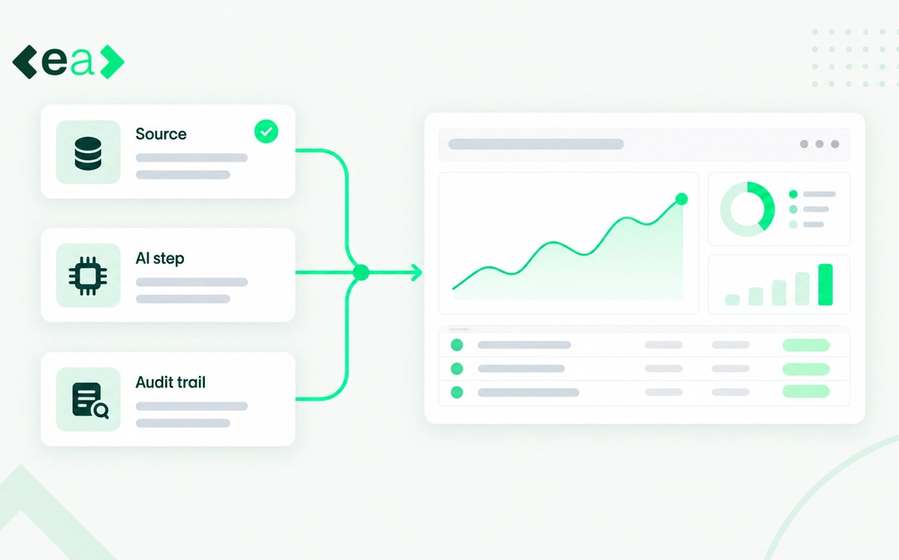
When using EA to complete an RFP, rather than starting with a blank prompt, the tool first searches your organisation's approved knowledge base, previous responses, and supporting documentation to identify the most relevant information for specific requirements. It then uses that trusted knowledge to generate a contextual first draft that reflects your organisation specifically. From there, responses can be reviewed, refined, and tailored to the customer's needs, giving you the time back that you would have previously spent searching for information or recreating the answers that you have written before.
The Benefits of Purpose-Built AI RFP Software
By bringing together trusted organisational knowledge and AI-powered drafting, EA is designed to solve the day-to-day challenges that those responsible for RFPs face. From responding faster to reducing repetitive work, here are four ways that purpose-built AI RFP software can transform the RFP process.
- Respond Faster
Finding the right information is often the longest part of the RFP process. By surfacing relevant answers from trusted company knowledge and using them to create a contextual first draft, EA helps teams respond more quickly without compromising on the quality that you would usually expect.
2. Reduce Repetitive Work
Many RFPs ask the same or similar questions. Instead of recreating answers or searching through previous submissions, EA helps teams to reuse previously approved knowledge, reducing repetitive tasks while ensuring responses remain relevant to each opportunity.
3. Improve Consistency
When responses are created from a central source of approved knowledge (within your EA knowledge base), teams are less likely to use outdated information or inconsistent messaging. EA helps to ensure that every response reflects the latest product information, compliance evidence, and company messaging.
4. Give Experts More Time
The greatest value of an RFP professional isn't writing the same answers repeatedly, but applying their expertise to understand customer requirements, refine messaging, and strengthen their proposals. By reducing the repetitive manual effort usually required for RFP submissions, EA gives teams more time to focus on the work that has the biggest impact.
Rethinking the Role of AI in RFP Responses
The organisations that get the most value from AI in the RFP process won't be those only using it to write faster, but those using it to surface trusted knowledge, reduce repetitive work, and give their experts more time to focus on creating the responses that lead to results.
Do you want to see how this approach works in practice? Book a demo or try it free to discover how EA helps RFP teams retrieve trusted knowledge, generate contextual first drafts, and respond with greater speed and confidence.