

What to Tell a Client Questionnaire About Your Use of AI
Clients are now asking how their suppliers use AI, and many of the questions arrive with no agreed wording and no evidence behind it. This article helps you decide what to say, what to attach, and how to answer accurately without overstating what your team controls.
By EA Team
Contents
- The question arrives before the policy does
- Start from the register you already keep
- Write answers a reviewer can check
- Match the answer to the client's risk
- Decide in advance what you will not claim
- Build the answer with the people who approve it
- Keep the wording in one place
- Answer well, and be plain about what is in progress
A client's AI questions are reasonable, and answering them well is a chance to show how your team works. The difficulty is that the questions often arrive before anyone has written an agreed position, so the answer gets assembled under deadline from whatever different people happen to know.
This article explains how to read a client's AI questions, build answers from what your team really uses, attach evidence a reviewer can check, and agree the wording before the deadline. It covers what to say, what to attach, and how to keep the answers consistent from one client to the next. A prepared, consistent answer is easier to defend than one written under pressure.
The question arrives before the policy does
A procurement team sends a supplier questionnaire that has a section on artificial intelligence. The questions are reasonable: which tools touch client data, whether any data trains a model, who approves AI-generated content, and how the supplier handles errors. The bid manager reads the section and realises nobody has written an agreed position. Different people have been using different tools, and the policy describes intentions while day-to-day practice has moved on.
This is a common gap. Teams adopted AI during day-to-day work, and the formal documents followed later, if at all. A client's questionnaire is often the first time someone has to put the whole picture into one place, under deadline.
Start from the register you already keep
The factual base for every AI answer is the list of tools your team uses and the providers behind them. If you have built a provider register, as checking which AI provider handles your client data sets out, that register is the first place to look. It already names the tools, the model providers, the processing locations and the retention position, which is most of what a client's AI section asks for.
Where the register is thin, fill the gap before you write the answer. Include the tools that were adopted informally, since those are the ones a client is most likely to test. For each one, note what kind of information it handles, who uses it, and which provider sits behind it.
Be honest about the scope. If one tool is approved for drafting and another is used only for internal research, say so. Clients ask these questions to understand exposure, and a clear scope reads as competence.
Write answers a reviewer can check
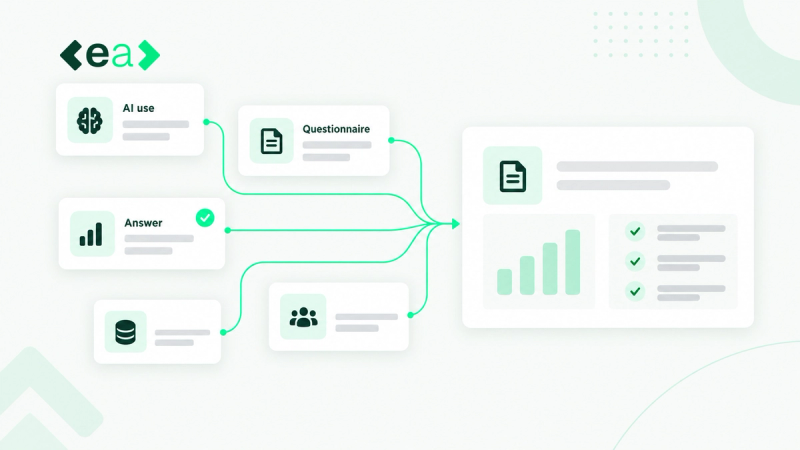
A checkable answer has four parts: what the tool does, what data it handles, what control applies, and where the evidence sits. For example, a sentence might say that drafting assistance is used for questionnaire responses, that client material is processed by a named model provider under that provider's written terms, that every AI-drafted answer is reviewed and approved by a named person before it is sent, and that the record of review is kept for each response.
Avoid phrases that cannot be verified, such as "fully secure" or "AI-safe". They tell the reader nothing and invite the question "how do you know?" If a control is still being rolled out, say so and give the date you expect it to be in place. An honest timeline is more credible than a claim that will not survive the first audit.
Then attach the evidence that answers the client's follow-up questions before they ask. That usually means a short AI use statement, the register of tools and providers, a sample of the review record for one answer, and the relevant section of your information security policy.
If your answers are produced in EA, the evidence is partly built in. Autofill completes questionnaires from approved evidence and shows citations, so a reviewer can trace each statement to its source. Answers carry statuses and version history, and named reviewers and approvers leave comments on the answer itself. Those features give you a record that matches what the client is asking for. Approval decisions across channels explains how that review trail is built in practice.
Match the answer to the client's risk
Clients do not ask the same AI questions for the same reasons. A regulated financial client may focus on data residency and retention. A public sector buyer may ask about bias, human oversight and the audit of automated decisions. A large corporate customer may want to know whether its information is used to train any model. Read the questionnaire to find which risk sits behind each question, and tailor the answer to that risk.
The efficient way to do this is to keep a fixed core of AI wording that is true for every client: the tools in use, the providers behind them, the review step, and the record that is kept. Then add a short variable layer for each client, covering the specific data involved, any contractual commitment and the contact who owns the relationship. This keeps the answers consistent while allowing the detail a client expects.
A tailored answer also helps your own team. When a reviewer knows why a question matters, they can judge whether the evidence actually addresses it. A sentence that answers the wording of a question but misses its purpose will be spotted, and the follow-up will arrive.
Decide in advance what you will not claim
Some questions will go beyond what your team controls. A client may ask for a guarantee that a model provider never retains prompts, or for a specific certification your firm does not hold. The honest response is to state what you can evidence, identify the part that depends on a third party, and say how you will supply the rest.
Agree that position with your legal and information security leads before the questionnaire arrives. If the wording changes from one client to the next, make sure the differences are deliberate and can be explained.
Build the answer with the people who approve it
The AI answers should be written by the people who can stand behind them. The information security lead confirms the controls, the legal lead checks the commitments, and the bid manager owns the wording. Set up a short review where these three roles agree the core text before the first questionnaire of the year, so the negotiation does not happen under a deadline.
A named approver on each answer, with comments kept against that answer, means that the final text reflects the people responsible for it. When a client asks who checked the wording, the answer is already on the record.
Keep the wording in one place
Store the agreed AI answers in your answer library, with an owner and a review date. When the next questionnaire arrives, the person completing it starts from the approved wording, so nobody has to rewrite it under pressure. When a tool or provider changes, the owner updates the answer and records the change.
Clients also respond well to a commitment to review. If a control is still being rolled out, or a provider is changing its terms, say so and give the date you will next confirm the position. A dated promise that you then keep is worth more to a reader than a complete-sounding answer that is out of date within a quarter. Log that date in the answer library, so the owner sees it when the review falls due. That single habit turns an answer from a one-off statement into a living record, and it gives the next questionnaire a clearer starting point.
Track which variable details you have given to which client. If a commitment appears in one response, check that you can honour it everywhere it is repeated. Inconsistent answers across clients are one of the quickest ways to lose the trust that a single good answer earned.
External requests also need internal sign-off. External requests and internal approval describes how to route these answers through the people who must approve them before anything goes to a client.
Answer well, and be plain about what is in progress
A client's AI questions are reasonable, and answering them well is a chance to show how your team works. Name the tools, describe the controls that apply, attach evidence a reviewer can check, and be plain about what is still in progress. Specific, honest answers are harder to write than reassuring ones, and they are the ones that hold up.
If you have an AI section in an upcoming questionnaire, book a demo and we can show you how EA's citations and approval trail would support the answers you give.
Filed under RFPs, Tenders & Questionnaires, 26 October 2026All posts