
How to Improve Your EcoVadis Score Through Better Evidence
EcoVadis scorecard improvement depends on the work behind the submission and the evidence that demonstrates it. Map requirements to current documents, assign practical actions and maintain the evidence between assessment cycles.
By EA Team
Contents
- Begin with the requirement behind the score
- Separate practice gaps from evidence gaps
- Current evidence carries more weight in review
- Turn the result into an improvement plan
- Use the score to improve the underlying work
- Preparation should continue between assessments
- Questions to ask when improving your score
- How EA can support the process
An EcoVadis score can fall short of an organisation’s expectations even when useful sustainability work is already happening. A policy may sit with governance, a target may be monitored by operations and supporting records may be held by different teams.
When the next assessment opens, the submission team needs to understand the scorecard requirement, locate the current evidence and explain how the material supports the response. The quality of that preparation shapes how clearly the organisation’s work appears to the assessor.
EcoVadis scorecard improvement therefore depends on two connected forms of progress: strengthening the underlying practice and making the practice visible through relevant, current evidence. The submission process gives the organisation a way to diagnose both.
Begin with the requirement behind the score
It is useful to start with what the scorecard asks the organisation to demonstrate. A policy statement can show intent, while an assessment may also look for objectives, responsibilities, training, monitoring, procedures, results and review records.
A broad commitment can leave the management of a specific issue unclear. Teams may know that relevant work exists yet struggle to identify which document answers a particular requirement. They may upload a large set of files without explaining the connection, or write a short response that leaves important evidence elsewhere.
Improvement starts with a mapping exercise. For each requirement, identify the expected practice, the evidence available, the owner of that evidence and any part of the response that still needs work.
Separate practice gaps from evidence gaps
A scorecard result becomes more useful when the team examines the reason behind the score. The gap may be substantive: a process, target, measurement method or ownership model needs to be created or strengthened.
The gap may also be evidential. The work exists, while the submission team lacks an accessible document or a clear explanation of how the material answers the requirement. These situations call for different actions.
A missing process needs operational improvement. An evidence gap may need better document ownership, clearer source mapping, approved wording or stronger preparation between cycles. The distinction helps the team spend time on the cause of the result.
The organisation can record each gap with an action, owner, due date and evidence requirement. That turns a scorecard insight into a manageable improvement process.
Current evidence carries more weight in review
The strength of a submission depends partly on the relevance and currency of its evidence. A replaced policy can create uncertainty. A certificate outside its validity period may fail to support the expected claim. A report may contain useful information while requiring a clearer explanation of its relationship to the requirement.
Evidence also needs maintenance between assessment cycles. When a policy changes, a target is updated or responsibility moves to another team, future submissions should reflect that change. A controlled document and approval process can help the organisation identify what changed and decide which statements remain ready to reuse.
This is where EcoVadis success starts with the right evidence provides a useful related perspective. Evidence becomes more useful when it is connected to the question, owner and review status instead of being held as an undifferentiated archive.
Turn the result into an improvement plan
The most useful response to an EcoVadis result connects each gap to an action and a way to demonstrate progress later.
If a submission lacks evidence that environmental objectives are monitored, the action may involve defining a metric, assigning responsibility and setting a review rhythm. If the evidence exists yet was hard to connect to the response, the action may involve organising the source information and establishing approved wording for the next assessment.
The plan should remain close to the work. A sustainability lead may own the requirement, an operations manager may own the process and a document owner may maintain the evidence. Clear roles help the organisation make progress before the next deadline arrives.
Use the score to improve the underlying work
A submission can become a document exercise when the team focuses only on preparing more persuasive explanations for the next cycle. A stronger process connects the result to ownership and operational decisions.
Each gap should lead to a decision about what needs to change, who is responsible and what evidence will show that the change has happened. The action may involve updating a procedure, improving measurement, clarifying accountability or recording how a review is performed.
The evidence then becomes a record of the organisation’s work and progress. It gives the submission a stronger basis while helping management judge whether the improvement is taking place in practice.
Automation can help make previous responses, source documents and identified gaps easier to retrieve. Management and subject matter experts decide what the organisation should improve, so the workflow needs to keep evidence and unresolved questions visible.
Preparation should continue between assessments
The strongest preparation happens throughout the year. Teams can maintain ownership of key policies, record changes to targets and keep evidence close to the work it describes.
This reduces the pressure that arrives when the next assessment opens. It also lets the organisation address a weak area while the decision, process or metric remains current. A review rhythm helps prevent evidence from becoming an annual reconstruction exercise.
The efficient EcoVadis submission guide explores how approved documents and previous responses can support the next review. The same principle applies to improvement actions: the work becomes easier when the organisation preserves what it learned.
Questions to ask when improving your score
A useful review should ask:
- What did the scorecard require the organisation to demonstrate?
- Which evidence was available at the time?
- Was the evidence current and within scope?
- Did the response explain the connection clearly?
- Was the gap operational, evidential or both?
- What action will change the underlying position before the next cycle?
- Who owns the action and the evidence?
- How will the organisation know that the improvement has been implemented?
These questions turn score improvement into a repeatable process that guides action after each assessment.
The next submission should be easier for a reason. When requirements connect to current evidence, clear owners and recorded actions, the organisation can focus on strengthening the work and explaining it accurately.
The review record also helps new contributors understand the history behind each action.
How EA can support the process
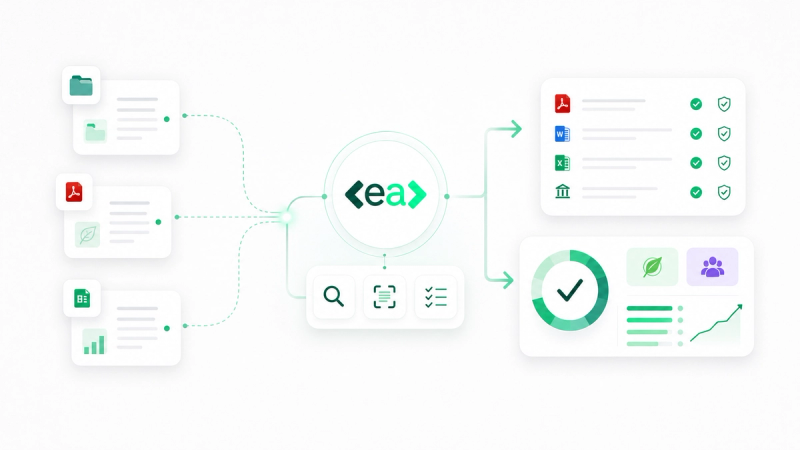
EA can support the EcoVadis evidence workflow in two connected ways. First, it can help teams carry out gap analysis by comparing assessment questions with the organisation’s current practices, evidence and previous responses. This gives the team a clearer view of what is missing, what needs updating and which actions should be prioritised.
Second, EA has access to the organisation’s knowledge base of documents, identifying and attaching the correct evidence to the correct EcoVadis questions. Policies, procedures, reports and other approved records can be brought into the review with their context, so the team spends less time searching and more time checking relevance, currency and scope.
Together, these capabilities help connect each question to the right evidence and each evidence gap to a practical improvement action. Human review remains essential: sustainability leads and subject matter experts decide whether the evidence is accurate, current and suitable for submission.
If your team spends each assessment cycle rebuilding the same evidence trail, book an EA demo or try EA free to explore a more connected workflow.
Filed under ESG News, 25 August 2026All posts