
How to Build an Escalation Process for Overdue Reviews
Overdue reviews usually get another email, and another after that, until people stop opening them. This article explains why repeated reminders lose their effect and how to build an escalation process that gets a response.
By EA Team
Contents
A financial controller is asked to confirm an audited revenue figure for a tender due in three days. The first email arrives on Tuesday. On Wednesday a second message arrives with "Reminder" in the subject line. On Thursday the bid lead copies her manager. She has read every email. The figure depends on the audit file, which sits with her team and which nobody has asked her to pull. Each message says "please review" and none of them says what is stuck.
This article covers why repeated reminders stop working, what an effective chase contains, where the chase should live, and how to agree an escalation rule before you need it. The aim is that a stalled review gets a response without a fourth email.
Why the third reminder gets ignored
A reminder carries weight only if it changes what the reader knows. Repeating the request adds pressure but no information. After the second identical message, most people conclude that the sender is anxious, without showing why the task is urgent. They reply with a short note that the work is "in hand", and the section stays where it was.
There is a second problem. Generic reminders often arrive through a channel unconnected to the work. The reviewer has to open an email, find the document, locate the section and work out what the sender wants. Each of those steps is a small cost, and together they make the task easy to postpone.
What an effective chase says
A useful chase names three things. It says what is waiting, using the answer or section. It says what is blocking progress, such as a missing figure, an unresolved comment or a policy that has not been confirmed. It says what decision is needed, whether that is an approval, an amendment or a named replacement if the reviewer cannot take the task on.
The difference is easy to see. "Please review the financial section" gives the reader nothing to act on. "Section 6.2 needs your confirmation of the FY25 revenue figure. The audit file is in the finance folder, and the answer needs approving by Thursday noon. If you cannot confirm it, tell me who can" takes less effort to answer, and it leaves no room to misunderstand the task.
Keep the tone factual throughout. A chase that reads as a verdict on someone's diligence will get a defensive reply, and the review will stall for a different reason.
Where the chase should live
The chase is most useful when it sits with the thing it concerns. If the reason a review is waiting appears in a comment on the answer, anyone who opens the answer can see it, including the bid lead, the approver and the reviewer. The chase becomes part of the record, visible to everyone who needs it.
Status matters here too. An answer that is still in review shows the team where it is, and the team can see whether the review has moved since the last chase. A reviewer who responds in a comment, and then changes the status, has closed the loop in a way a reply email often does not.
Planning the escalation before you need it
Escalation is where most chasing plans fail, because the bid lead has to decide, under pressure, whether to go over a colleague's head. The fix is to agree the rule before the bid begins. A simple rule works well: if a review has not moved one working day before the deadline, the bid lead asks the approver directly, and if that does not work, the approver's line manager is told the status and the specific blocker.
Agreeing this in advance also helps the reviewer. They know what happens next, so the escalation does not come as a surprise, and the conversation with the line manager stays about the work.
How EA supports the chase
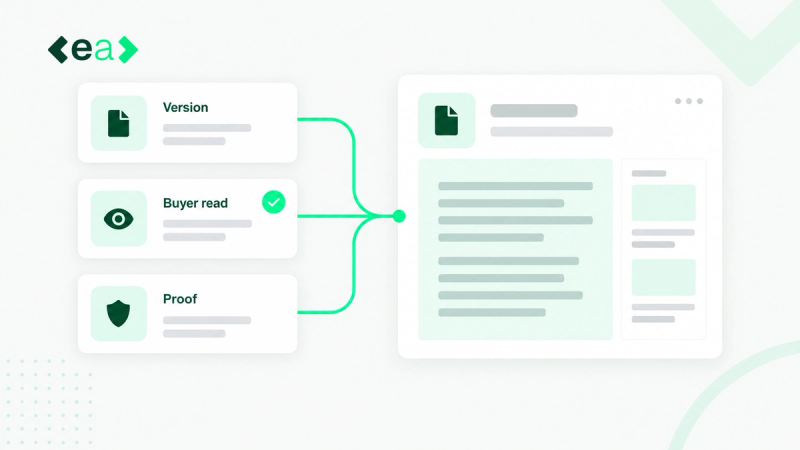
EA keeps the chase attached to the answer. Named reviewers and approvers sit on each answer, and comments let a reviewer state what is holding them up or record what they checked. Answers carry statuses, so the team can see which items are still in review and which have been approved. Version history shows when an answer last changed, so the chaser can tell whether a reviewer has responded to the latest wording.
Approval requests also run across email, Slack and Teams. A reviewer who lives in Teams can respond there, and the decision is recorded against the answer. This matters because the people you are chasing are often the ones who receive the most messages. Meeting them where they already work, with the specific answer in front of them, is more likely to get a reply than a fourth email in a crowded inbox. For a broader view of routing questions to the right specialist, see how a tender question reaches the specialist.
What EA cannot do is decide who should be chased, or when escalation is right. Those choices depend on how your firm allocates accountability and how close each deadline is. EA makes sure the choice is made with the current status and comments in front of the person making it. Our article on approval decisions across channels covers how decisions taken in email, Slack or Teams can still land on the answer itself.
Make the chase worth answering
Reminders fail because they add pressure without adding information. A chase that names the answer, the blocker and the decision needed gives a reviewer a reason to act, and an agreed escalation path keeps the bid moving when that does not work. EA helps by keeping the chase, the status and the reviewer's notes together on the answer, so the team spends less time wondering what happened last Thursday.
Before your next live bid, write down the escalation rule with your bid lead and approvers, and put the first chase into the draft as a comment.
If overdue reviews are holding up your bids, book a demo with EA and bring one live questionnaire, so we can show how comments, statuses and named approvers sit together on an answer.
Filed under RFPs, Tenders & Questionnaires, 10 November 2026All posts