Tender teams rarely work on a response alone. Sales may coordinate the bid while security checks control statements, legal reviews commitments, finance confirms commercial details and delivery specialists test whether the proposed approach is realistic. Every contribution needs to reach the right person, use current information and return in time for final approval.
Those handoffs create much of the pressure behind a tender deadline. Answers sit in previous proposals, policies, shared drives and message threads. Reviewers work from different versions. Approvals arrive in separate channels with limited visibility of the wording that was authorised.
Tender response automation should bring these stages into one connected process. It should find approved content, adapt it to the buyer’s requirements, assign questions, support expert review and record the final decision. This article examines what that workflow involves and how teams can assess whether an automation platform will support the complete response.
A tender response brings several teams together
Contributions from various teams create a chain of dependencies. A delayed security check can hold up the commercial response. A revised technical answer can affect wording elsewhere in the submission. An approval captured without a clear version record can leave the team uncertain about what is ready to send. The document records the final outcome, while the response team needs visibility into each hand-off along the way.
The document is the visible output, but the work happens around it. If tender response automation only generates text, the team still has to manage the workflow through email, spreadsheets and separate document versions.
That creates familiar problems. A question is sent to the wrong person. A reviewer edits a response that has already changed. A claim is copied from an old proposal. An answer is approved in an email, but there is no clear record of which version was approved or why.
Automation should remove these points of friction while also accelerating the first draft.
The first draft still needs trusted knowledge
Most organisations have answered many of the questions in a new tender before. The difficulty is finding the approved version and applying it to the new context.
A response about data protection may already exist in a supplier questionnaire. A description of the implementation team may appear in a previous RFP. A security answer may be stored in a policy or a customer due diligence document. The organisation often has useful content available. The harder task is identifying which content is current, relevant and safe to reuse.
This is where a useful AI RFP software platform should connect drafting with organisational knowledge. It should retrieve relevant approved answers and supporting documents, then adapt them to the wording and requirements of the new tender.
Approved knowledge still needs to be adapted to the current opportunity. A buyer may ask the same underlying question in a different format or with a different emphasis. The response should reflect that context while allowing the team to build on information that already exists.
Review is part of the automation
A generated response becomes ready for submission after the responsible people have assessed its accuracy, completeness and suitability for the buyer.
That review process should be visible inside the same workflow. Teams need to know which questions are ready, which are waiting for input and which still require approval. Reviewers should be able to add comments, explain changes and return an answer for revision without creating another disconnected version.
This matters for answers that describe security controls, regulatory commitments, implementation timelines or customer outcomes. A fluent answer can still be wrong. The workflow should make expert review easy and place it alongside the automation.
Approval also needs to be recorded properly. If a response is approved in an email or message, the organisation should be able to understand what was approved and when. That record supports accountability when a bid is submitted and makes future responses easier to maintain.
What tender response automation should handle
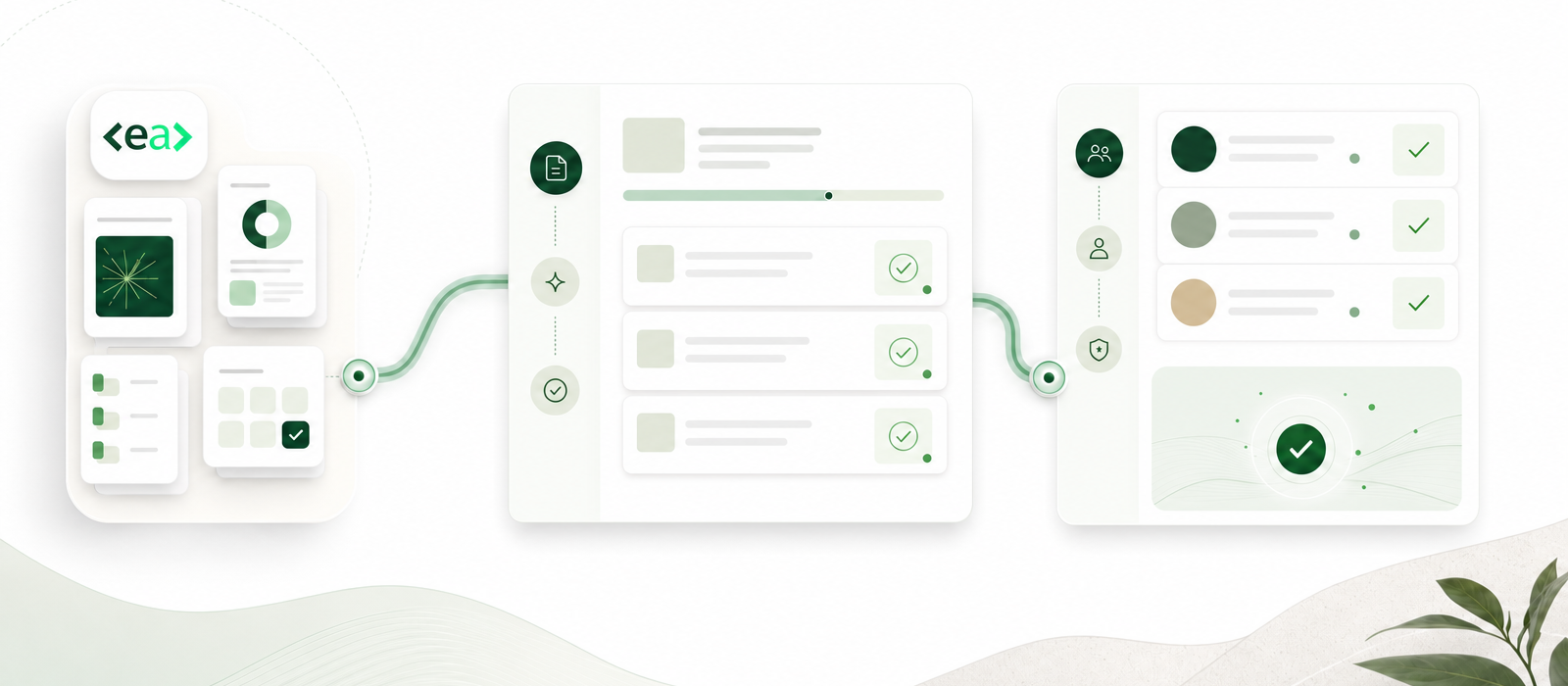
A practical system should support the full path from question to approved response. That includes:
- identifying questions and grouping related requirements;
- finding relevant approved answers and evidence;
- drafting responses in the required tone and format;
- assigning questions to the right contributors;
- allowing reviewers to comment and request changes;
- tracking the status of each answer;
- recording approvals and the final version; and
- exporting the completed response in the buyer’s required format.
People remain responsible for decisions that require judgement. Automation gives them more time for those decisions by handling search, copying, pasting and version reconciliation.
Where EA fits
EA is designed around the work that surrounds a response as well as the text inside it. It can search approved organisational knowledge, reuse previous answers, adapt them to a new question and prepare a draft for review.
The team can then work through the response in a structured process. Questions can be reviewed, edited and approved with the source information and submission status visible. The draft gives experts a clear starting point and the context they need to make a decision.
The practical benefit is straightforward. A bid team spends less time hunting through old submissions and more time deciding what the current buyer needs to know. Subject matter experts review the parts that depend on their expertise while familiar background information is prepared from approved knowledge. The organisation also has a clearer record of the knowledge it has approved for reuse.
The deadline exposes weak hand offs
The pressure of a tender deadline often reveals whether the response process is genuinely connected. A technical reviewer needs the question's context to address the buyer's concern. The bid manager needs a clear final status to prevent duplicate review. The team also needs a reliable record of the wording authorised for submission.
These process conditions directly affect the quality of the document. A late response may be shortened before it receives enough review. A missing source may lead to cautious but unhelpful wording. A rushed change can introduce a claim before the person who owns the subject has checked it.
Good tender response automation should make these handoffs easier to see. It should show what is waiting, what needs attention and what has already been approved. That visibility is as important as the generated text because it gives the team a practical way to keep the response moving without losing control.
The better test for automation
A useful evaluation asks how the tool supports the complete tender response. Most modern AI tools can produce a plausible answer, while a strong platform also connects that answer to knowledge, ownership, review and approval.
The better questions are:
- Can it find the organisation’s approved knowledge?
- Can it show where a response came from?
- Can it adapt an answer without losing its meaning?
- Can it involve the right people at the right stage?
- Can it make comments, changes and approvals visible?
- Can it preserve human control over important claims?
Those questions reveal whether the platform supports a real tender response workflow or simply produces text faster.
The first draft matters, but it is only one step between receiving a tender and submitting a response the organisation can stand behind.
If your team is still moving answers between an AI tool, email and a shared document, it may be worth looking at how a more structured RFP workflow could reduce the work around drafting as well as the drafting itself.
Want to see how EA can support your RFP workflow? Book a demo or try it free now.