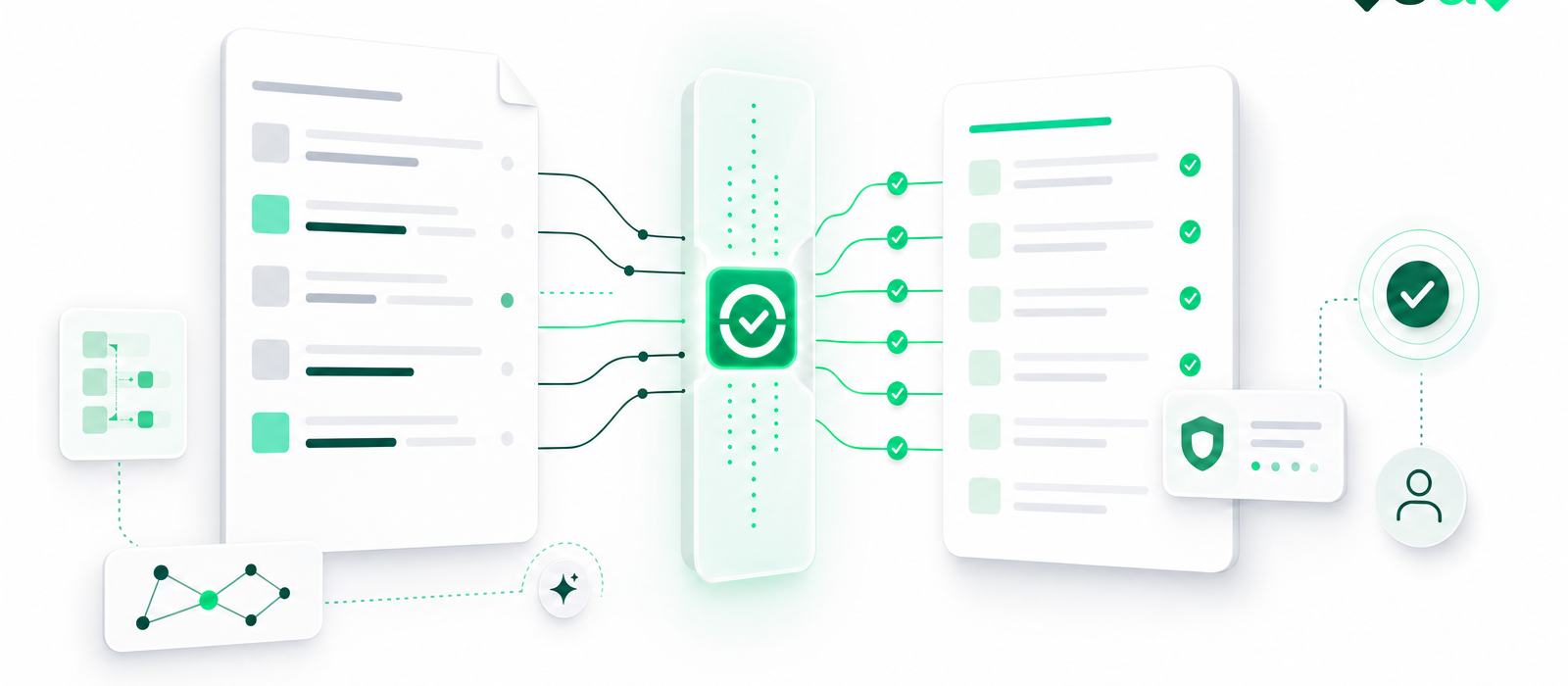
An RFP response can look complete on the surface and still contain missed questions, unsupported claims, inconsistent answers or simple compliance errors.
The final review is where these issues should be caught. But when teams are manually checking long responses against the original RFP, it is easy for important details to slip through.
Before you submit, ask these seven questions.
1. Have We Answered Every Question?
An RFP response is only as complete as its least obvious unanswered question.
When a document contains dozens or even hundreds of questions, it is easy to overlook a sub-question, skip a table or assume that one answer covers another requirement when it does not.
A final quality check should compare the response against the original RFP and identify:
- Questions that have not been answered
- Partially answered questions
- Sections that have been missed
- Requirements that have not been addressed
This is one area where AI for bid quality checks can reduce manual review. Instead of relying on someone to work through the RFP line by line, AI can help identify gaps between the buyer's requirements and the completed response.
2. Have We Met Every RFP Requirement?
Answering the question is not always enough. The response also needs to follow the buyer's specific requirements.
That might include:
- Mandatory requirements
- Required response formats
- Word or character limits
- Specific documents or evidence
- Instructions about how information should be presented
- Evaluation criteria that the response will be scored against
Missing one of these details can undermine an otherwise strong submission.
An automated check can compare the response against the original instructions and flag areas that need attention before submission.
3. Are Our Answers Based on Approved Information?
RFP responses often require teams to pull information from across the organisation: company policies, previous responses, case studies, certifications, security documentation and more.
The problem is that finding an answer is not the same as finding the right, approved answer.
Using old documents, outdated statistics or an unapproved version of a company statement can introduce unnecessary risk.
A better process gives teams a way to find relevant information from their existing knowledge while maintaining control over what is used in the final response.
This is particularly valuable when different people are contributing to the same bid and need to work from a consistent source of truth.
4. Do We Have Evidence to Support Our Claims?
Strong RFP responses do more than make claims. They demonstrate them.
If a response says your organisation has extensive experience, strong security controls or a proven track record, can you point to the evidence that supports that statement?
Before submitting, check that important claims are backed by relevant and current material, such as:
- Case studies
- Certifications
- Policies
- Performance data
- Customer examples
- Accreditations
- Internal documentation
AI can help teams work more efficiently here too. Rather than manually searching through folders and previous responses, it can surface relevant supporting information alongside the answer being drafted.
5. Are Our Answers Consistent Throughout the Response?
Long RFPs are rarely written by one person.
Sales might write some sections. Subject-matter experts might contribute others. Legal, security or compliance teams may review specific questions. Previous responses may also be reused as a starting point.
That creates a simple problem: different parts of the same response can end up saying different things.
Check for inconsistencies in:
- Company descriptions
- Statistics and figures
- Product or service descriptions
- Processes and policies
- Terminology
- Customer examples
- Claims about capabilities
Reusing approved answers and checking them against the wider response can help prevent these contradictions from making it into the final submission.
6. Does Every Answer Address What the Buyer Is Looking For?
An answer can be technically correct and still fail to address what the buyer actually wants to know.
For example, a buyer might ask how you manage information security incidents but specifically evaluate responses based on response times, escalation procedures and customer notification.
A response that only describes the organisation's general incident response process may answer the question without addressing the criteria that matter most.
Before submitting, check whether each answer:
- Directly addresses the question
- Covers the buyer's stated requirements
- Reflects the evaluation criteria
- Provides the level of detail requested
- Demonstrates the relevant capability or outcome
This is where understanding the RFP before drafting becomes just as important as checking the finished response.
AI can help identify the requirements and evaluation criteria within an RFP, giving teams a clearer framework for developing responses that are relevant rather than simply complete.
7. Has the Response Been Properly Reviewed and Approved?
The final draft should not simply be the point where the writing stops. It should be the point where the right people can review the response with confidence.
A strong review process should make it clear:
- Who is responsible for each section
- Which answers need subject-matter review
- What has been changed
- Which issues are still outstanding
- Who has final approval
This matters because RFP responses often involve sensitive, commercially important information. The goal is not to remove people from the process. It is to make their involvement more focused and effective.
From RFP Quality Checks to a Better Bid Workflow
Quality checking should not mean sending a completed RFP to someone and asking them to find everything that might be wrong.
By that point, the team has already invested hours into searching for information, drafting answers, checking requirements and coordinating reviews.
A better approach is to build quality checks into the RFP response workflow from the beginning.
AI can help identify requirements, find relevant approved information, surface supporting evidence, flag gaps and check responses against the original RFP. Humans can then focus on the decisions that require their expertise: refining the answer, validating the information and approving the final response.
That turns quality assurance from a final hurdle into part of the process.
With bid writing workflow automation, organisations can reduce the repetitive work involved in preparing and checking RFP responses while keeping the people who know the business firmly in control.
This means a more consistent, controlled and reliable way to get the right response in front of the buyer.
See How EA Can Automate Your RFP Workflow
EA was purpose-built to automate the repetitive work involved in preparing, checking and managing RFP responses, from finding approved information and identifying gaps to checking requirements and coordinating review and approval.
Want to see how EA could support your organisation's RFP process? Book a demo, try EA for free.