California Climate Disclosures: What Companies Need to Know
California’s SB 253 and SB 261 redefine corporate climate reporting across the United States. Together, these two laws create a state-level framework requiring large companies to disclose both their greenhouse-gas emissions and their exposure to climate-related financial risks.
If your organisation does business in California and meets the revenue thresholds, your first disclosures will be due in 2026. Here’s what you need to know – and how EA can help you prepare.
Why these laws matter
The Climate Corporate Data Accountability Act (SB 253) and the Climate-Related Financial Risk Act (SB 261) establish complementary but distinct expectations.
- SB 253 focuses on quantitative emissions data, requiring companies to report their Scope 1, 2 and 3 greenhouse-gas emissions.
- SB 261 focuses on qualitative governance and risk disclosures, requiring companies to report a climate-related financial risk report.
Together, these frameworks are shaping how climate transparency will be regulated at both the state and federal level – and the ripple effects will extend far beyond California.
Who is affected and what’s required
- SB 253 applies to companies with global annual revenues above USD 1 billion. It requires annual disclosure of Scope 1 and 2 emissions (starting 2026) and later Scope 3 emissions, calculated and reported in line with the GHG Protocol’s A Corporate Accounting and Reporting Standard.
- SB 261 applies to entities with revenues above USD 500 million. It requires a biennial climate-related financial risk report aligned with the TCFD Recommendations or an equivalent framework, such as IFRS S2.
Both laws are administered by the California Air Resources Board (CARB). While enforcement will begin after a short “good-faith” phase-in, companies are expected to demonstrate credible alignment from the start.
What businesses need to do now
- Review existing disclosures. Determine whether current sustainability or ESG reports already address TCFD and GHG Protocol elements.
- Identify gaps. Many reports cover emissions or risk in isolation; these new laws require structured, standard-aligned disclosures.
- Plan for assurance. SB 253 requires third-party verification of GHG data. Documentation and consistency will be key.
- Integrate data and narrative. Emissions data that satisfy SB 253 will also inform the risk assessments required under SB 261.
How EA helps you prepare
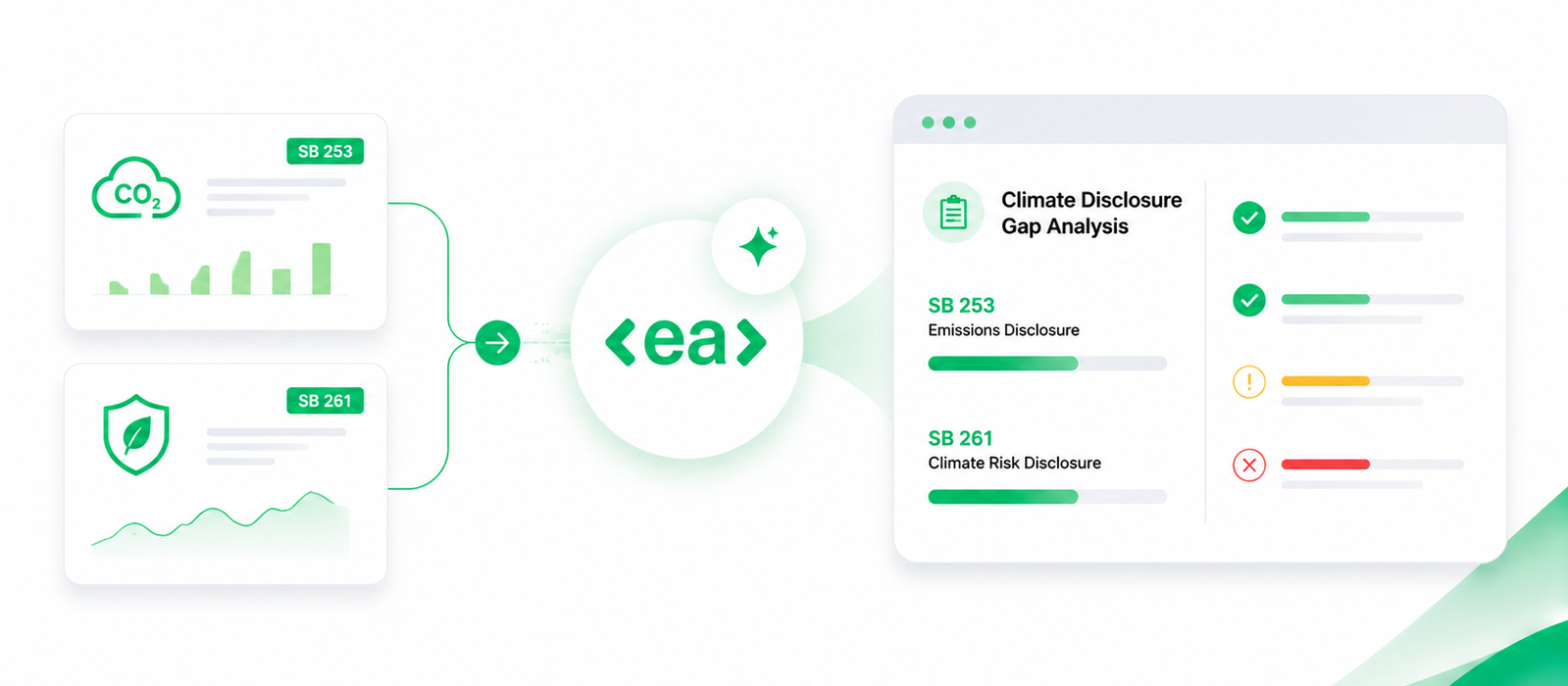
EA’s new California Climate Disclosure Gap Analysis uses artificial intelligence to review your existing or draft disclosures and assess their alignment with:
- The GHG Protocol – A Corporate Accounting and Reporting Standard (for SB 253), and
- The TCFD – Recommendations of the Task Force on Climate-related Financial Disclosures (for SB 261).
By running your documents through our AI, you’ll receive an analysis highlighting where your reporting already meets best-practice standards and where it falls short.
The output pinpoints focus areas – such as boundary definitions, emission scope completeness, governance, or scenario analysis – to guide your next disclosure cycle.
This readiness assessment helps companies refine their 2025 reports so that their 2026 California filings are accurate, credible, and aligned with international expectations.
Looking ahead
California’s climate-disclosure rules will set the benchmark for U.S. and global regulation. With EA’s gap-analysis workflow, you can quickly understand how your current disclosures stack up against the GHG Protocol and TCFD, so that when 2026 arrives, compliance is simply confirmation.
Book a 15-minute call or try EA for free today (No card required)
Related Articles
EcoVadis Automation Case Study
CDP & Ecovadis Questionnaire Automation with EA Pricing Features and Enterprise Scaling
EcoVadis Scoring Changes 2024: What Companies Must Prepare For
Read More